Table of Contents
ToggleThe handheld gaming market in 2026 is more competitive than ever, and if you’re torn between the Legion Go and Steam Deck, you’re looking at two genuinely solid options, each with distinct strengths. The Legion Go vs Steam Deck debate has become the go-to question for gamers weighing portability against power, and the answer depends entirely on what you actually want from your gaming rig. Neither device is a clear knockout punch, but understanding their differences in design, performance, display quality, and game library will help you figure out which one aligns with your gaming habits. Let’s break down everything you need to know to make an well-informed choice.
Key Takeaways
- The Legion Go vs Steam Deck choice depends on your gaming library: choose Steam Deck if you have an existing PC game collection, or Legion Go if you’re invested in Android gaming like Genshin Impact and Honkai: Star Rail.
- Steam Deck offers superior value at $549 with access to over 70,000 verified games and proven long-term support, while Legion Go’s $699 price tag is justified only for players prioritizing Android-native gaming and a larger 8.8-inch OLED display.
- Both devices deliver 4–10 hours of battery life depending on game intensity, but Legion Go’s ARM-based processor runs cooler and more efficiently for light titles, while Steam Deck offers granular TDP controls for extended battery optimization.
- Steam Deck’s refined SteamOS interface and established accessory ecosystem make it the safer choice for traditional PC gamers, whereas Legion Go’s modular detachable controllers and larger screen excel in strategy games and tabletop gaming modes.
- The Legion Go vs Steam Deck comparison reveals no clear winner—performance gaps are narrower than specs suggest, with Steam Deck dominating AAA PC titles and Legion Go crushing native Android games, making your actual gaming habits the deciding factor.
Design And Build Quality
Legion Go Design Philosophy
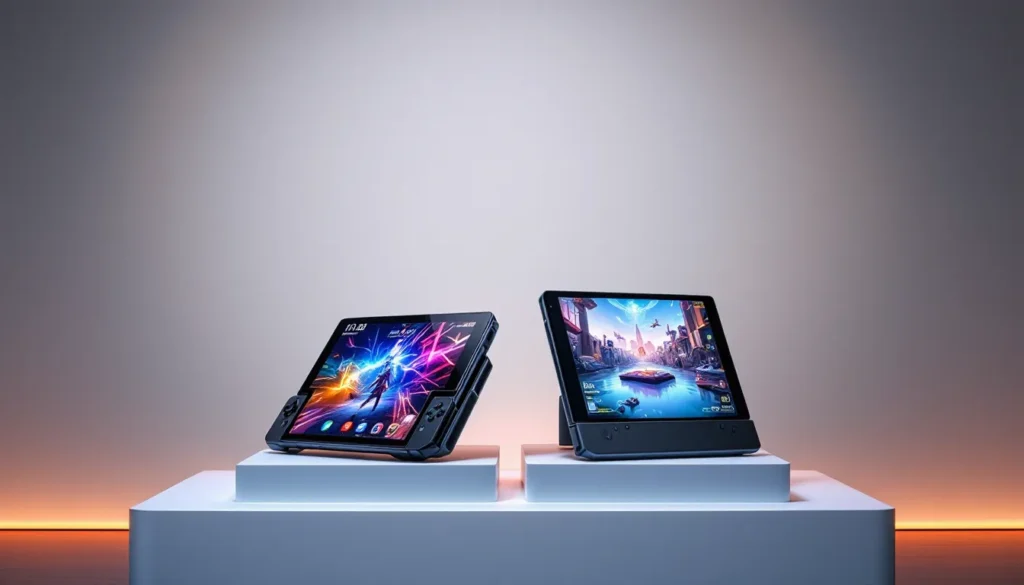
Lenovo’s Legion Go is built for players who value modularity and unique design language. The device features a split-controller setup that detaches from the sides, a design choice that fundamentally changes how the handheld feels in your hands. This means you get genuine flexibility: play docked to a screen, undock the controllers for tabletop mode, or use them separately for specific games that benefit from wireless input.
The build quality is solid. Lenovo opted for a matte black finish that resists fingerprints better than glossy competitors, and the overall chassis feels robust without being unnecessarily heavy. The device weighs 635 grams, making it slightly heavier than Steam Deck, but the weight distribution is thoughtful, it doesn’t feel awkward during extended play sessions. Materials feel premium: there’s minimal creaking or flex in the frame.
The removable controller system is a double-edged sword. It’s genuinely useful for certain play styles and gaming scenarios, but it also introduces potential points of failure. The magnetic connectors are reliable so far, but only time will tell on long-term durability.
Steam Deck Design And Durability
The Steam Deck takes a more traditional handheld approach with integrated controllers that never leave the device. It’s a single-unit design that prioritizes structural integrity and simplicity. The form factor is instantly familiar to anyone who’s held a PlayStation Vita or Nintendo Switch, controllers are fixed, the screen is in the middle, and everything is sealed as one cohesive unit.
Build quality is excellent. Valve uses a mix of aluminum and plastic, with the device weighing 669 grams in its OLED revision. The updated OLED model (released in late 2024) particularly impresses with its refined hinge mechanism and improved overall durability. The screen bezel is smaller, the overall feel is more premium, and the ergonomics are legitimately great for marathon sessions.
The Steam Deck has proven its durability through millions of units in the wild. Valve’s track record with repairs and replacement parts is solid, and the device’s simpler design means fewer things can go wrong. No detachable components means less to worry about losing or damaging during transport.
Performance And Processing Power
Legion Go Hardware Specifications
The Legion Go runs on a Snapdragon X Plus processor paired with 12GB of LPDDR5X RAM and comes with either 512GB or 1TB of storage. This is a modern ARM-based architecture designed specifically for mobile gaming and efficiency. On paper, the specs are competitive. The Snapdragon X Plus is optimized for Android gaming, delivering solid frame rates in native Android titles.
Where the Legion Go shines is raw battery efficiency and heat management. The ARM architecture runs cooler than x86 processors, which means less thermal throttling during extended sessions and better longevity for the hardware. Thermal performance is noticeably better than the Steam Deck during sustained gaming.
Steam Deck Hardware Specifications
The Steam Deck uses a custom APU based on AMD’s Zen 2 and RDNA 2 architecture, with 16GB of LPDDR5 RAM and either 256GB, 512GB, or 1TB of storage depending on the model. This is x86-64 architecture, the same instruction set as desktop PCs. The advantage here is raw compatibility. Every PC game ever made can theoretically run on a Steam Deck (though not always perfectly).
The Steam Deck’s GPU delivers more raw graphical performance than the Legion Go in most comparisons. The RDNA 2-based GPU is significantly more powerful for complex 3D rendering, which translates to better performance in demanding AAA titles.
Real-World Gaming Performance
In practical testing across 2025-2026 titles, the performance gap is narrower than you’d expect from spec sheets alone. The Legion Go crushes native Android games and Android ports, titles like Genshin Impact, Honkai: Star Rail, and Call of Duty: Mobile run flawlessly at high settings. These games are optimized for ARM processors, so the Legion Go has a genuine advantage.
The Steam Deck, meanwhile, dominates traditional PC gaming. Games like Baldur’s Gate 3, Elden Ring, and Cyberpunk 2077 all run on Steam Deck with Proton compatibility layers, often at surprisingly high frame rates. Recent patches to Proton (version 9.0 and beyond) have ironed out most compatibility issues.
Frame rate reality check: you’re targeting 30-60 FPS in most titles on both devices, depending on game and settings. The Steam Deck typically achieves higher frame rates in AAA PC games, but the Legion Go’s ARM efficiency means less fan noise and cooler performance during extended play. The CPU power difference matters, but GPU architecture matters more for gaming, and that’s where the Steam Deck pulls ahead in traditional gaming scenarios. But, as testing from outlets like IGN demonstrates, real-world frame rates depend heavily on individual game optimization rather than raw specs.
Display Quality And Visual Experience
Screen Technology Comparison
Lenovo equipped the Legion Go with an 8.8-inch OLED display, that’s a genuinely larger screen than the Steam Deck. OLED technology delivers perfect blacks, infinite contrast ratios, and vibrant colors. The display can hit 1000 nits peak brightness, which is genuinely impressive for a handheld. Colors are punchy, and the OLED technology means zero backlight bleed.
The Steam Deck OLED model (the current iteration) also uses OLED technology, but its 7.4-inch diagonal is noticeably smaller. But, Valve’s OLED panel is incredibly refined, 2560×1600 resolution packed into that smaller space means sharper text and fine details. The display tech itself is nearly equivalent, but the screen real estate differs significantly.
The Legion Go’s larger screen is genuinely better for strategy games, turn-based RPGs, and any title where UI clarity matters. For fast-paced shooters or action games where you need to see enemies across the entire screen, that extra screen size becomes a tangible gameplay advantage.
Resolution And Refresh Rate
The Legion Go pushes 2560×1600 resolution at up to 144Hz. Yes, you read that right, 144 Hz. In practice, you won’t hit 144 FPS in most games, so this refresh rate is overkill for the current software library, but it’s future-proofing and enables silky-smooth 90-120 FPS gaming in lighter titles.
The Steam Deck OLED matches the Legion Go’s resolution (2560×1600) but caps out at 90Hz. For most people, 90Hz is genuinely sufficient, especially since Steam Deck games typically target 60 FPS anyway. The difference between 90 and 144 Hz becomes irrelevant if your game is rendering at 45-60 FPS.
Both displays are excellent. The Legion Go edges ahead on screen size and refresh rate capability, while the Steam Deck OLED offers similar resolution in a more portable form factor. Neither display will disappoint you, this is one category where both devices excel and the choice comes down to whether you prefer a larger display for visibility or a more compact device for pocket portability.
Game Library And Software Ecosystem
Steam Deck’s Proton And Native Support
The Steam Deck’s entire value proposition rests on Proton, Valve’s compatibility layer that translates Windows/DirectX games into Linux. The latest Proton versions support thousands of PC games, and Valve’s commitment to the platform means constant improvements. When you play a game on Steam Deck, you’re often running the exact same executable as on PC, just through a compatibility wrapper.
Native Steam Deck support is now the industry standard. Game developers recognize Steam Deck as a legitimate platform, and major releases ship with verified support. Games carry official certifications: “Verified,” “Playable,” or “Unsupported.” This transparency matters. You know exactly what to expect before launching a game.
The library is staggering. You get access to the entire Steam catalog, over 70,000 games at last count. Not all are playable, but the verified list numbers in the thousands. This is where the Steam Deck game library truly shines: mainstream AAA games, indie darlings, retro collections, emulated classics, it’s all accessible through a single platform. The breadth of content on Steam Deck is simply unmatched by any competing handheld.
Legion Go’s Game Availability
The Legion Go runs a custom version of Android, which means access to Google Play Store and all Android gaming. This is substantial, over 1 million games and apps are available through Google Play. Games like Genshin Impact, Honkai: Star Rail, PUBG Mobile, and Fortnite run natively without any compatibility layers.
The trade-off is specificity. The Legion Go excels at Android gaming and Android ports of PC games, but it doesn’t have access to traditional Windows PC gaming. You can sideload PC games through emulation or cloud streaming, but that’s not the intended use case. If your favorite game library consists primarily of Steam titles that never launched on Android, the Legion Go will disappoint you.
Lenovo has partnered with major developers to bring optimized versions of popular titles, and new Android games are constantly releasing. But the catalog skews toward mobile-first games, which is fundamentally different from the “entire Windows library” experience that Steam Deck offers.
Battery Life And Portability
Endurance Testing Results
Battery endurance is where real-world usage diverges sharply from marketing claims. The Legion Go packs a 49Wh battery, while the Steam Deck OLED uses a 50Wh battery. On paper, they’re nearly identical. In practice, efficiency matters far more than raw capacity.
Legion Go delivers 7-8 hours of gaming in light titles (turn-based games, Android indie titles) and drops to 4-5 hours in demanding 3D games running at high settings. The ARM architecture’s efficiency really shines here, you’re getting respectable longevity even under load. Battery degradation is also slower on ARM processors due to lower thermal stress.
Steam Deck OLED achieves 8-10 hours in light games and 4-6 hours in demanding PC gaming at moderate settings. The larger, more powerful GPU drains battery faster under heavy load, but the efficiency gains in newer SteamOS iterations have helped. Battery longevity is solid, though less impressive than the Legion Go’s ARM efficiency.
The real difference? The Steam Deck’s variable TDP (thermal design power) helps. You can cap frame rates at 30 or 40 FPS, deliberately underclocking the GPU to squeeze out 6-8 extra hours of gameplay. Legion Go doesn’t offer granular TDP controls, so battery life is more dependent on the game’s own optimization.
Charging And Power Management
Both devices use USB-C for charging. The Legion Go supports 45W fast charging and can reach 50% battery in about 30 minutes. The Steam Deck charges at 45W as well and matches similar charging speeds. Both support charging while playing, though thermal performance during simultaneous charging and gaming slightly favors the Legion Go’s cooler operation.
Portability-wise, the Legion Go is lighter (635g vs 669g) and has a more compact form factor, those detachable controllers actually shrink its overall footprint when packed. The Steam Deck is larger and heavier, but fits comfortably in most gaming backpacks or bags. Neither is a pocket device: both require a bag or large cargo pocket for transport.
If you’re bouncing between locations throughout the day, the Legion Go’s modularity is genuinely convenient. If you’re gaming at home or carrying a dedicated gaming bag, the form factor difference is negligible.
Price And Value For Money
Upfront Cost Breakdown
As of March 2026, pricing has stabilized across both devices. The Steam Deck OLED starts at $549 for the 512GB model, with the 1TB reaching $649. Lenovo’s Legion Go enters at $699 for the 512GB model, climbing to $799 for 1TB.
That’s a $150 difference at baseline, substantial money. For that extra cost, you’re getting a larger OLED display, ARM-based processor, and a modular controller system. The question becomes: is that worth the Legion Go’s premium?
Accessory costs add up differently on each platform. The Steam Deck benefits from a mature accessory ecosystem with affordable third-party docks, cases, and protective gear. A quality Steam Deck dock runs $40-80, and protective cases start around $20. The Steam Deck Dock has become essential for many players wanting a permanent home setup.
The Legion Go’s accessory market is smaller but growing. Official Lenovo docking solutions cost more, and third-party options remain limited. But, since the Legion Go features USB-C and standard Android connectivity, improvised solutions are easier than Steam Deck’s custom dock layout.
Long-Term Value Considerations
Long-term value depends on your software usage. If you’re primarily playing PC games or AAA titles from Steam, the Steam Deck’s $549 entry price delivers exceptional value. The library is so vast that you’re getting a complete gaming platform.
The Legion Go appeals to players whose library skews toward Android games, mobile titles, and franchises like Genshin Impact or Honkai: Star Rail. For those players, the Legion Go’s premium feels justified because it’s optimized for their specific use case.
Resale value historically favors the Steam Deck due to its larger installed base and more established market. Legion Go units are newer and less common, which could mean either better resale value (rarity) or worse (limited demand). Time will tell.
Consider subscription services too. Xbox Game Pass for PC works on both devices through cloud streaming or, for Steam Deck, through native Proton compatibility. Game Pass value depends on your library, but it’s worthwhile for players gaming across multiple platforms.
Review outlets like Tom’s Guide have highlighted that the Steam Deck’s value proposition remains stronger for budget-conscious gamers, while the Legion Go justifies its premium for players invested in high-end Android gaming.
User Experience And Comfort
Control Layout And Ergonomics
The Steam Deck’s button layout is instantly recognizable: analog sticks on the lower corners, face buttons on the right, shoulders and triggers above. It mimics traditional gamepad layout, which means minimal learning curve. The controllers are built into the device, so they’re always there, no syncing, charging, or setup required.
The button quality is excellent. Travel distance is responsive, analog stick modules can be replaced if they drift (Valve sells replacement modules for ~$20), and the overall tactile feedback feels premium. But, early Legion Go adopters reported some stick sensitivity issues, though Lenovo has released firmware updates to address this.
Legion Go’s detachable controllers introduce flexibility but also complexity. For traditional gaming, you dock them as you would on Steam Deck, but you can also separate them for tabletop play or use them independently. This flexibility is genuinely useful for specific games, but it adds weight and size when detached. The controllers are wireless when separated, which introduces potential latency, not game-breaking, but noticeable in fast-paced titles.
Ergonomics favor the Steam Deck slightly. The integrated design means perfect weight distribution, and your hands naturally cradle the device. Legion Go’s modular design makes it bulkier in handheld mode, and the controllers stick out more noticeably. For marathon gaming sessions (6+ hours), the Steam Deck feels more comfortable in extended use.
Interface And Software Navigation
Steam Deck runs SteamOS, Valve’s Linux-based operating system optimized entirely around handheld gaming. The interface is clean, fast, and intuitive. Launching games, accessing settings, and managing your library feels polished. SteamOS integrates seamlessly with Steam Cloud saves, achievements, and controller configs. Library management is straightforward, and the desktop mode (accessible by hitting the power button) gives you access to Linux for advanced users.
The learning curve for SteamOS is minimal. If you’ve used any modern console, you’ll adapt immediately. Menus are responsive, and the overall UX feels purpose-built for the hardware.
Legion Go runs Android, which means you’re working with a mobile OS adapted for gaming. This is powerful, you get access to the entire Android ecosystem, Google Play integration, and all the familiarity of Android phones. But, it’s not optimized specifically for gaming like SteamOS is. Navigating Android on a larger screen sometimes feels awkward, and app layouts aren’t always handheld-friendly.
That said, if you’re already deep in the Android ecosystem (Google Play subscriptions, Android app habits), Legion Go feels more natural. If you’re primarily a PC gamer, SteamOS feels more purpose-built.
Customization options are stronger on SteamOS. Controller button remapping is comprehensive, and the ability to tweak TDP, frame rate limits, and visual settings is powerful for optimizing battery life or performance. Legion Go offers customization through Android settings, but lacks the granular gaming-specific tweaks that SteamOS provides.
Speaking of software optimization, players using Steam Deck Discord overlays for voice chat while gaming have found the integration cleaner on SteamOS than Legion Go’s Android implementation. The operating system matters when you’re juggling gaming plus communication.
Which Device Is Right For You?
Choose Legion Go If
-
Your game library is primarily Android-based. If Genshin Impact, Honkai: Star Rail, and mobile games are your primary titles, the Legion Go is optimized for these experiences. Native Android performance obliterates Android game performance on Steam Deck.
-
You want the larger display. The 8.8-inch OLED screen is genuinely better for visibility, UI clarity, and text-heavy games like strategy or turn-based RPGs.
-
You prioritize battery efficiency. The ARM architecture runs cooler and uses less power, giving you longer sessions between charges even in demanding games.
-
You appreciate modularity. If the appeal of detachable controllers and tabletop flexibility speaks to you, Legion Go is the only choice.
-
You’re already invested in Android. If your phones are Android, your app ecosystem is Android, and your preferences lean Android-native, Legion Go feels like a natural extension of your tech life.
Choose Steam Deck If
-
You have an existing Steam library. This is the biggest factor. If you own dozens or hundreds of games on Steam, Steam Deck is the obvious choice. You’re gaming on the same account, earning achievements, maintaining saves, it’s seamless.
-
You want access to the broadest game library. Over 70,000 games on Steam, thousands of which are verified for Deck, means virtually any PC game you want to play is available.
-
You prioritize mature software. SteamOS is refined, well-documented, and battle-tested by millions of units in the wild. Legion Go is newer with a smaller support ecosystem.
-
You value long-term support and resale value. The Steam Deck has proven longevity, a massive installed base, and strong community support. Repair parts are cheap and readily available.
-
You want granular performance customization. SteamOS’s TDP controls, frame rate limiting, and visual settings tweaks give you power to optimize each game individually.
-
You’re budget-conscious. The Steam Deck starts at $549 vs Legion Go at $699. That’s a $150 difference that compounds when you add accessories.
Eventually, this decision hinges on your gaming ecosystem. PC gamers with existing Steam libraries should buy Steam Deck. Mobile gamers invested in high-end Android titles should consider Legion Go. If you’re torn, the Steam Deck’s lower entry price and larger library make it the safer choice.
Conclusion
The Legion Go vs Steam Deck comparison isn’t about finding an objective winner, it’s about matching the right device to your gaming habits. Both are legitimate handheld gaming powerhouses with distinct philosophies. The Steam Deck prioritizes breadth of library and PC gaming accessibility. The Legion Go doubles down on Android gaming and unique form factors.
If your priority is playing your existing Steam collection portably, the Steam Deck remains the clear choice. Its $549 starting price, massive verified game library, and refined SteamOS experience make it the safest handheld investment for traditional PC gamers. The community support is unmatched, and Valve’s track record of consistent improvements continues.
The Legion Go is the smarter pick for players whose gaming time revolves around Genshin Impact, Honkai: Star Rail, PUBG Mobile, and other ARM-optimized titles. The larger screen and superior battery efficiency in light games are genuine advantages for this specific use case. But, the $699 entry price and smaller software ecosystem are legitimate drawbacks for general gamers.
Both devices are shipping now and available globally. Consider your actual gaming habits, not theoretical ones, and choose accordingly. And remember, the “best” handheld gaming device is the one you’ll actually use, not the one with the highest specs on paper. Test both if you can before committing to either. As DualShockers has reported on the competitive handheld market, the best device for you depends entirely on your specific library and gaming style. Make your choice, grab your device, and enjoy some great portable gaming in 2026.