Table of Contents
ToggleThe Steam Deck OLED has officially become the gold standard for portable PC gaming. Since its launch, gamers have been wrestling with the question: is the Steam Deck OLED price worth the investment? With 2026 bringing new regional pricing, stock patterns, and bundle opportunities, it’s the perfect time to break down exactly what you’re paying for and whether pulling the trigger makes sense for your setup. Whether you’re eyeing the Steam Deck OLED 512GB or debating between the 256GB and 512GB models, this guide walks you through current pricing, where to actually buy one, and whether the specs justify the cost compared to competitors.
Key Takeaways
- The Steam Deck OLED price stands at $549 for the 256GB model and $649 for the 512GB model in the US, with no price increase since launch, offering stable value compared to competing handhelds.
- OLED display technology delivers tangible benefits over the LCD version, including deeper blacks, faster response times, improved thermal efficiency, and quieter fan operation that enhance both visual quality and portability.
- Real-world battery life ranges from 4–5.5 hours for demanding games like Cyberpunk 2077 to 8–10 hours for lighter titles, making the Steam Deck OLED practical for extended gaming sessions without a desk setup.
- Budget an additional $130–$170 beyond the device price for essential accessories including a protective case ($30–$60), screen protector ($8–$15), and official dock ($89) to create a complete gaming system.
- The Steam Deck OLED 512GB is worth the extra $100 investment if you plan multi-year ownership and want 15–20 games available without reinstalling, while the 256GB model suits budget-conscious buyers who manage storage actively.
- Compared to gaming laptops and competitors like the ROG Ally, the Steam Deck OLED delivers superior value for portable gaming because it maintains true portability, better battery efficiency, and full access to your Steam library with proven software support.
What Is The Steam Deck OLED And Why The Hype?
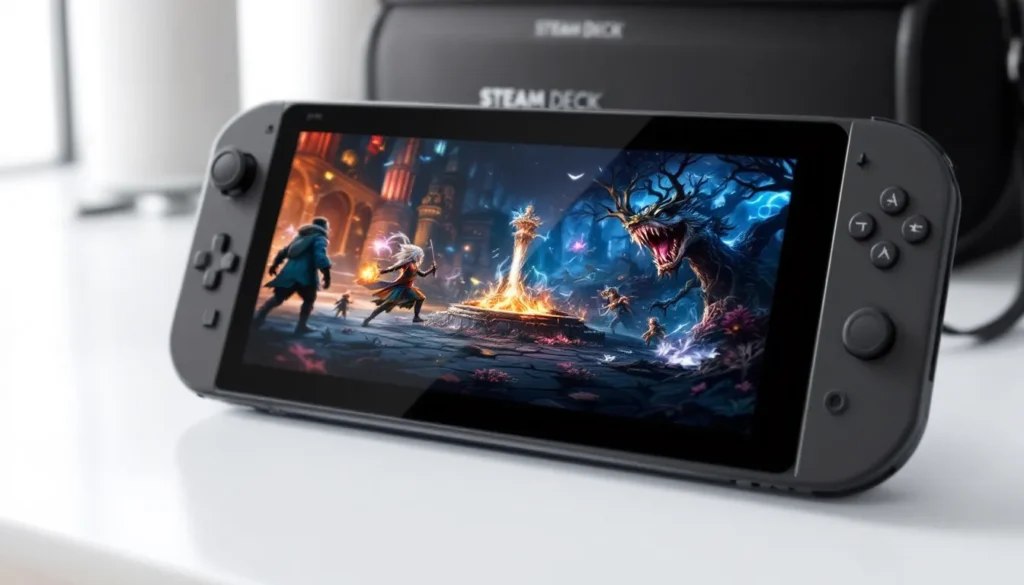
The Steam Deck OLED is Valve’s refined revision of their handheld gaming PC. The core appeal hasn’t changed: it lets you play your full Steam library on the go, from demanding AAA titles to indie gems. What’s different is the display and overall refinement.
Valve swapped the LCD panel from the original Steam Deck for a vibrant OLED screen. This translates to deeper blacks, better contrast ratios, and more vivid colors without the washed-out feeling of the older model. The OLED panel also has a faster response time, which matters for fast-paced games where input lag feels sluggish.
Beyond the screen, the OLED model got a thermal redesign. The device runs cooler under load, which means quieter fan operation, a big deal when you’re trying to enjoy story-driven games in quiet environments. The battery also received a marginal bump in capacity and efficiency, extending playtime for lighter games.
The hype exists because portability at this performance level was rare before the Steam Deck. You’re getting desktop-class gaming hardware squeezed into something that fits in a backpack. The OLED version cements that achievement with a display that finally feels like a premium experience instead of a compromise.
Current Steam Deck OLED Pricing Breakdown
Official Valve Pricing By Storage Capacity
As of 2026, Valve’s official Steam Deck OLED pricing sits at:
- Steam Deck OLED 256GB: $549 USD
- Steam Deck OLED 512GB: $649 USD
These prices are set directly by Valve and represent the standard retail cost across most official channels. The 256GB model gives you solid breathing room for a mid-sized game library, while the Steam Deck 512GB offers roughly double the storage for $100 more. Whether that extra capacity justifies the cost depends on your download habits, we’ll get into that shortly.
It’s worth noting that Valve hasn’t changed the OLED pricing since launch, which is rare in the gaming hardware space. Most competitors push prices up or introduce limited-run premium versions. This stability gives buyers confidence that you’re not overpaying just because it’s the newest version.
The original LCD model is being phased out but occasionally pops up in clearance. If you spot a Steam Deck 256GB at a discount, it’s a lower-cost entry point, though the display downgrade is noticeable once you experience OLED.
Regional Price Variations
Pricing gets messier outside the US. Here’s the breakdown for major regions:
- Canada: CAD $799 (256GB) and CAD $949 (512GB)
- UK: £449 (256GB) and £549 (512GB)
- EU: €459 (256GB) and €569 (512GB)
- Australia: AUD $919 (256GB) and AUD $1,099 (512GB)
These prices reflect local taxes, import duties, and regional distributors. Australian gamers consistently pay a premium, blame geography and logistics. European pricing sits somewhere in the middle relative to USD conversion rates, while Canadian pricing tracks closely to US dollars plus 27% GST/HST depending on province.
If you’re buying from outside the US, check local retailers for occasional bundle deals or sales. Some regions offer the device cheaper through independent shops than official channels, though warranty support can get murky in those cases.
How The OLED Model Compares To The LCD
The LCD Steam Deck 256GB and 512GB models are cheaper, typically $349 and $449 respectively when available. That’s a $200 savings on the 256GB or $200 on the 512GB compared to OLED. But here’s what you lose:
Display Quality: The LCD panel has visible color banding in gradients and washes out in bright environments. OLED blacks are genuinely black, not dark gray. Gaming in HDR-capable titles feels completely different on OLED.
Refresh Rate: Both panels technically support 90Hz, but OLED has better motion clarity due to lower response times. Fast-paced shooters and fighting games feel snappier.
Efficiency: The OLED model’s power improvements mean slightly longer battery life on the same hardware. We’re talking 20–30 minutes extra on a charge depending on the game.
Thermal Behavior: The OLED runs quieter because of better heat dissipation. The original LCD can sound like a small jet engine when playing demanding titles.
If money is tight and you can’t stretch to OLED prices, the LCD isn’t a bad compromise. But anyone considering the Steam Deck OLED 512GB shouldn’t question the OLED premium, it’s the tangible difference in every gaming session.
Where To Buy The Steam Deck OLED In 2026
Official Valve Store And Wait Times
Valve’s official website (steampowered.com) is the most straightforward place to order. The queue system is gone as of 2026, you can generally order and receive a Steam Deck OLED within a few weeks depending on your region. Shipping typically takes 5–10 business days after order processing.
The upside of buying from Valve: guaranteed authenticity, full warranty support, and no markup. The downside is that Valve only ships to select regions. If you’re in an unsupported country, you’ll need an alternative.
Valve occasionally runs limited promotions, especially around major Steam sales events in June and December. These aren’t usually price cuts (Valve doesn’t discount hardware), but they might bundle free games or offer free shipping. Keep an eye on their storefront leading up to those dates.
Third-Party Retailers And Alternatives
Major retailers now stock the Steam Deck OLED consistently:
- Best Buy: Same price as Valve, in-store pickup available in the US
- Amazon: Occasionally cheaper through third-party sellers, but verify “sold by” before buying
- Newegg: Reliable stock, sometimes offers bundle deals with cases or screen protectors
- GameStop: Carries both OLED and LCD models
- International retailers: AmazonUK, Currys, JB Hi-Fi (Australia), and regional equivalents
When buying from third-party retailers, verify that the seller offers a valid warranty. Some international third-party listings bypass Valve’s warranty entirely, which is a gamble. Read recent reviews and check return policies before committing.
Price-wise, third-party retailers rarely undercut Valve significantly, but bundle deals can offer real value. A retailer might throw in a carrying case, screen protector, or extra thumbstick at no additional charge. Calculate the true value, a decent Steam Deck case alone costs $30–60 separately.
Avoid sketchy marketplace sellers promising “crazy deals” on the Steam Deck 512GB at $50 off. Counterfeits exist, and recovering your money is a nightmare. Stick to established retailers with return policies.
Value For The Price: Is The Steam Deck OLED Worth It?
Performance Upgrades And Display Benefits
The Steam Deck OLED, whether you grab the 256GB or 512GB version, doesn’t introduce new performance specs. The processor, RAM, and GPU are identical to the LCD. You’re paying for refinement, not raw power upgrades.
But here’s the thing: refinement matters more than people assume. The OLED display is a 7-inch panel with 1280×800 resolution. That’s not cutting-edge by smartphone standards, but on a small screen, the pixel density feels sharp. OLED colors pop in ways LCD simply can’t match.
If you’re playing narrative-heavy games like Baldur’s Gate 3, Elden Ring, or Hades, the OLED display makes the experience feel more immersive. Games with darker themes (horror titles, stealth games) genuinely benefit from true blacks. Colorful indie games like Dave the Diver or Pizza Tower look noticeably vibrant by comparison.
The refresh rate floor also matters. OLED maintains consistent response times even when frame rates dip, so you don’t get the ghosting effect that happens with LCD panels during frame drops. It’s subtle but present.
Battery Life And Thermal Improvements
Valve claims 8–10 hours of battery life on the OLED model, depending on the game and settings. Real-world testing shows:
- Heavy games (Cyberpunk 2077, Baldur’s Gate 3): 4–5.5 hours
- Medium games (Stardew Valley, Elden Ring): 6–7.5 hours
- Light games (Indie titles): 8–10 hours
The OLED’s efficiency improvements add about 20–30 minutes of extra playtime compared to the LCD under identical conditions. Not earth-shattering, but valuable on long trips or commutes.
Thermal performance is more noticeable. The original LCD runs loud when pushed, the fan can get distracting. The OLED redesign with better heat pipes and fan optimization keeps noise levels down. You’ll still hear the fan in quiet environments, but it’s not the high-pitched whine that plagued early reviews.
This matters if you’re gaming in quiet spaces: study halls, libraries, or late-night sessions without disturbing others. The OLED’s thermal design makes that realistic.
Game Library And Compatibility
The Steam Deck library has exploded. Most major AAA releases now have official Valve certification or work through Proton. You’re not choosing the Steam Deck OLED for exclusives, you’re choosing it because your entire Steam library fits in your pocket.
Storage matters here. The difference between 256GB and 512GB is real when building a game library:
- 256GB: Fits ~7–10 modern AAA games (accounting for OS)
- 512GB: Fits ~15–20 modern AAA games
If you rotate games frequently, 256GB works fine. You’ll reinstall, but storage-to-playtime ratios favor having a library ready to go. The Steam Deck 512GB eliminates reinstallation anxiety and is worth the extra $100 if you have the budget.
Compatibility is excellent across genres. Fighting games, shooters, RPGs, strategy titles, they all run. Some require manual tweaks or controller remapping (Proton compatibility can be finicky), but the baseline experience is stable. Check Steam Deck Availability: Your for which games hit their best performance on the platform.
Budget Considerations And Financing Options
Payment Plans And Monthly Options
Valve doesn’t offer financing directly on their store, but third-party retailers do. Best Buy offers their credit card with 0% APR on purchases over $399 for 12 months, you could finance the Steam Deck OLED 512GB interest-free, then pay it off across the year.
Amazon also runs occasional promotional financing through their store card. Check availability during promotional periods (usually around major shopping events).
Some banks and payment platforms like Affirm or Klarna offer buy-now-pay-later options. You’d pay $49–$65 per month for 12 months. These aren’t great deals mathematically (you’re paying the full price upfront psychologically, spread across months), but they help if cash flow is the issue.
PayPal Credit is another route if you prefer paying directly through PayPal checkout. Terms vary, but 0% APR offers exist during promotional periods.
The practical takeaway: don’t buy on a credit card charging 20% APR unless you can pay it off immediately. Financing makes sense if you find 0% APR offers, otherwise, save up and pay cash.
Accessories You’ll Want To Budget For
The Steam Deck price you see isn’t the real total cost. You’ll want to budget for:
Essential:
- Case: $30–$60 (protects your investment during travel)
- Screen protector: $8–$15 (prevents scratches, though OLED glass is tougher than LCD)
- Extra thumbstick: $10 (wear items: Valve sells replacements)
Highly Recommended:
- Dock: The official Valve Steam Deck Dock: Unlock runs $89 and enables HDMI output, USB expansion, and charging simultaneously. Without it, you’re limited to USB-C docking via third-party solutions.
- eGPU consideration: For demanding titles, an external GPU dock isn’t officially supported, but third-party USB-C docks with eGPU capability exist. This is niche and expensive ($200+).
Nice-to-Have:
- Top 5 Steam Deck: Premium hard cases add durability for serious travelers.
- Steam Deck Matte Screen:: Reduces glare if you game outdoors: minimal performance impact.
- Maximize Your Gaming with: Standard 3.5mm jack works great: quality wireless earbuds eliminate cable clutter.
- Steam Deck Power Supply:: The 45W charger is standard: fast chargers exist but don’t dramatically speed up charge times.
Realistic total if you buy bare minimum: $549 (256GB OLED) + $40 (case + protector) + $89 (dock) = $678. The Steam Deck 512GB hits $778 fully equipped. This matters when budgeting, the device itself is half the ecosystem cost for a complete setup.
Steam Deck OLED Vs Competitors: Price And Performance
Handheld Gaming Alternatives In The Same Price Range
The Steam Deck OLED doesn’t exist in a vacuum. Let’s compare direct competitors:
ROG Ally (ASUS): $499–$649 depending on configuration. It uses an Intel CPU and targets the same market. Performance is comparable, but software is messier, Windows 11 is powerful but clunky on a small screen. The Ally feels like a portable gaming PC, not a dedicated handheld. Battery life is notably worse (3–4 hours under load).
Nintendo Switch OLED: $349. Completely different market, the Switch is a console first, portable device second. Game library is separate: performance is a generation behind. If you want Nintendo exclusives, it’s essential. For third-party gaming or your Steam library, the Steam Deck dominates.
Lenovo Legion Go: $699. Roughly the same price as the Steam Deck OLED 512GB but uses Snapdragon and Android. The detachable controllers are gimmicky: battery life is similar: software ecosystem is fragmented. It’s less mature as a device.
Retro gaming handhelds (Anbernic, Powkiddy): $150–$300. These target classic games and emulation, not modern gaming. Different audience entirely.
In terms of pure value, the Steam Deck OLED 512GB edges out competitors because you get your entire Steam library access, a mature OS, and proven third-party support. The ROG Ally is the closest competitor, but Windows overhead makes it less polished out of the box.
Value Proposition Against Gaming Laptops
Some gamers ask: shouldn’t I just buy a gaming laptop instead? Let’s break it down:
Gaming laptop ($649 entry-level): You get better performance, larger screen, and keyboard. But it’s not actually portable, it’s heavy (4–5 lbs), needs to sit on a desk or lap to function, has terrible battery life (2–3 hours gaming), and draws stares on flights and in coffee shops.
Steam Deck OLED: It’s genuinely portable. You pull it out anywhere. No setup required. Battery lasts 4–5 hours under load, which covers most gaming sessions. It weighs 0.88 lbs and fits in your bag.
The choice depends on your actual use case:
- Laptop if: You want to game at your desk with high-end graphics and don’t care about portability.
- Steam Deck OLED if: You want gaming on your commute, travel, or relaxing on the couch without carrying luggage.
They’re not competing products: they’re different solutions. If you have a gaming PC at home and want portable gaming, the Steam Deck OLED 256GB or 512GB is the smarter purchase than a gaming laptop. If you lack a home gaming setup and need portability, you might compromise and buy a lower-end gaming laptop. Most serious gamers end up with both, a home rig and a Steam Deck.
Final Verdict: Making Your Purchase Decision
Should you buy the Steam Deck OLED in 2026? Here’s the decision framework:
Buy the Steam Deck OLED 256GB if:
- You have a tight budget but want the OLED refinements.
- You rotate your game library and don’t mind reinstalling.
- You’re okay managing storage actively (uninstalling after finishing games).
- You primarily play indie titles or older AAA games that compress smaller.
Buy the Steam Deck OLED 512GB if:
- You want a library of 15+ games ready to play without management.
- You plan to own this for 3–5 years and want future-proofing as games get larger.
- You don’t want to reinstall games constantly.
- The extra $100 isn’t a hardship in your budget.
Skip the Steam Deck OLED if:
- You primarily play competitive online shooters where lag matters (the display helps, but it’s still a handheld playing across Wi-Fi).
- You need high-end settings and frame rates (you’ll compromise visual fidelity or resolution on demanding titles).
- You don’t own a PC and rely entirely on Steam’s Linux/Proton compatibility (some niche games won’t work perfectly).
- You need something with better battery life than 5 hours (nothing in this price range wins here).
Realistically, the Steam Deck OLED 256GB is the better value on paper, you save $100 and still get the OLED display. But the 512GB feels less cramped in practice. The deciding factor is honest self-assessment: Will you really manage storage, or will that annoy you?
The price-to-performance ratio is solid compared to gaming laptops or competing handhelds. You’re not overpaying for the OLED premium, display quality genuinely impacts daily use. The device has matured: SteamOS is stable: the software ecosystem has depth.
If you’ve been on the fence, 2026 is the time. Stock is reliable, pricing is consistent, and the library has never been larger. The Steam Deck OLED isn’t perfect, it’s a compromise device living between home gaming and true portability. But it’s the best compromise available at this price point, and it delivers on the promise of playing your PC games anywhere. Whether you grab the 256GB or splurge for 512GB, you’re getting genuine value. Check Steam Deck Archives – Slayercruise and broader gaming news outlets like IGN for the latest reviews and patches affecting compatibility. Recent coverage from GameSpot has highlighted improved emulation support, and Tom’s Guide regularly updates comparisons with competing handhelds. The device doesn’t need major justification anymore, it’s proven itself as the handheld gaming standard.
Conclusion
The Steam Deck OLED price sits at $549–$649 depending on storage capacity, and for 2026, those prices represent legitimate value in the portable gaming space. You’re paying for access to your entire Steam library in your hands, a gorgeous OLED display that makes games look genuinely good, and a device that’s proven its longevity through software updates and community support.
The real cost extends beyond the hardware, budget for a dock, a case, and replacements for wear items. But once you account for everything, the Steam Deck OLED ecosystem still edges out competitors when your priority is portability without compromise.
The decision between 256GB and 512GB hinges on your tolerance for storage management and long-term commitment. Both are capable machines. Both run the same games at the same performance levels. The distinction is lifestyle: Do you want a streamlined library or infinite games ready to play?
What matters most is honest intent. If you want to game on the couch, during commutes, or while traveling, the Steam Deck OLED delivers. If you want a desktop replacement, you’re asking the wrong device. It’s specialized hardware for a specific use case, executed better than any competitor in 2026. That’s why the price makes sense.